Google Now Scores Your Website for AI Agents. Most Sites Are Failing.
In May 2026, Google quietly added a fifth result to PageSpeed Insights, next to the four scores every website owner knows. It is called Agentic Browsing, and it does not measure how fast your site loads or how well it ranks. It measures whether an AI agent, browsing on behalf of your customer, can actually read your site and act on it. Most websites fail it. Here is what changed, why it matters more than it looks, and what it says about where the web is heading.
A fifth score just appeared.
For years, running your site through Google PageSpeed Insights gave you four verdicts: Performance, Accessibility, Best Practices, and SEO. In May 2026, Google shipped Lighthouse 13.3 with a new category, and by late May it was showing up in PageSpeed Insights for everyone: Agentic Browsing.
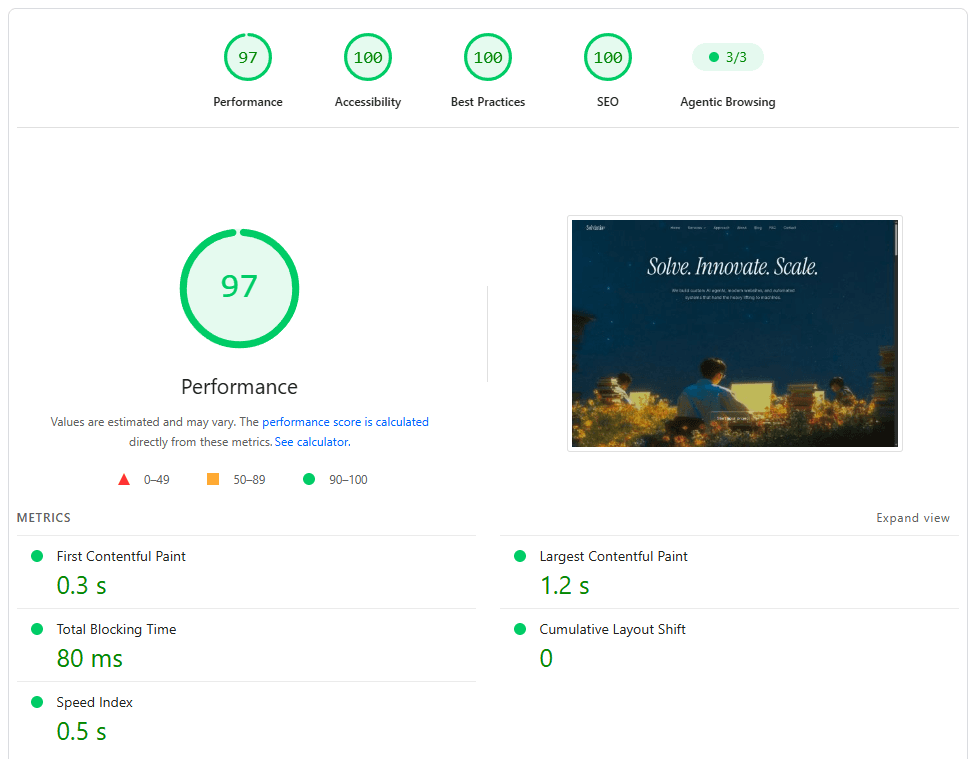
It does not score you from 0 to 100 like the others. It shows a pass ratio, like 1/3 or 3/3: how many agent-readiness checks your page passes out of the ones that apply. Google marks the category as experimental, which is exactly why it deserves attention. Experimental is what Google calls a measurement before it starts counting.
What agentic browsing actually is.
Until recently, two kinds of visitors came to your website: people, and search crawlers that indexed it for people. There is now a third kind, and it arrives with a credit card.
Agentic browsers are AI systems that navigate the web on a customer's behalf. ChatGPT's browser, Perplexity's Comet, and Gemini's agentic mode can be told "find me a photographer in Sydney and request a quote" or "book a table for six on Friday", and they will visit websites, compare options, fill forms, and complete the task. The person never sees your homepage. Their agent does.
That changes what "working" means for a website. A site can look perfect to a human and be unreadable to an agent: buttons that are just styled rectangles with no accessible name, layouts that shift while loading so the agent clicks the wrong thing, content locked inside scripts the agent cannot interpret. When that happens, the agent does not struggle politely. It leaves and completes the task on a competitor's site.
The three checks, in plain English.
The PageSpeed Insights result is currently built from three checks. None of them are exotic. All of them are the kind of thing that quietly rots on a website nobody is maintaining.
| Check | What it means | Where sites fail |
|---|---|---|
| Clean accessibility tree | The machine-readable map of your page: every button, link, and field properly named and structured, the same map screen readers use. | Div-soup builders and DIY page editors produce unnamed controls and broken structure. Humans see a button; agents see nothing. |
| Stable layout | The page does not shift around while it loads, so an agent that decides to click something is still clicking the right thing. | Late-loading banners, ads, and pop-ups that push content around. Annoying for people, disorienting for agents. |
| Valid llms.txt | A machine-readable summary at your domain root that tells AI systems what your site is, what it offers, and where the important pages are. | Most sites simply do not have one. It did not exist as a convention until recently, so no site built before it was set up will pass by accident. |
Does this affect my Google ranking?
Not today, and anyone who tells you otherwise is selling something. The Agentic Browsing result does not touch your other scores, and Google has made no announcement about it influencing search rankings. That is the honest answer, and it is also not the end of the story.
Google has a pattern. HTTPS started as a recommendation; in 2014 it became a ranking signal, and today a site without it shows a warning to every visitor. Mobile-friendliness started as a label; by 2018 Google switched to mobile-first indexing, and slow mobile sites sank. Core Web Vitals started as a developer dashboard; in 2021 they were folded into ranking. The sequence is always the same: Google starts measuring something publicly, gives the web time to adapt, then starts counting it. A brand-new category in PageSpeed Insights is the first step of that sequence, not a curiosity.
And the nearer cost has nothing to do with ranking. If an agent is doing the buying and your site is the one it cannot operate, you lose that customer today, while ranking exactly where you always did. Invisibility to agents does not show up in your search position. It shows up in enquiries that quietly stopped coming.
Why a perfect SEO score no longer means you are visible.
For twenty years, being found online meant one thing: rank in the ten blue links. That world is dissolving. Customers increasingly ask an AI assistant and act on its synthesized answer, and the assistant cites a handful of sources instead of listing ten. Being the answer and being a link are now different games, and the industry has split the work into four disciplines.
GEO: Generative Engine Optimization
Structuring content so large language models like ChatGPT, Gemini, and Claude cite you when they answer questions in your field.
AEO: Answer Engine Optimization
Shaping pages so they win the direct, synthesized answer in AI summaries and conversational search, not just a position on a results page.
LLMO: Large Language Model Optimization
The umbrella practice: structuring your brand's data so AI models understand it correctly and weight it when they are trained and grounded.
AIO: AI Overview Optimization
Winning the cited spots inside the AI Overview boxes that now sit above the traditional results in Google itself.
Set-and-forget is how websites disappear.
Here is the uncomfortable part. Every one of these standards is young and moving. Google labels Agentic Browsing experimental and is openly evolving the checks. The llms.txt convention barely existed two years ago. The AI systems deciding who gets cited update constantly. A website tuned perfectly in January is quietly out of date by June, and the owner is the last to know, because nothing visibly breaks. The site just stops being chosen.
This is why the websites that stay visible are not the ones that were built best once. They are the ones that are maintained as systems: measured against real data, updated when the standards move, and shipped continuously. On our own site, Search Console and analytics data feed directly into an AI loop that reads what real people actually search, then adapts copy and structure to match. When Google added a fifth score, we passed it the week we saw it, because someone was watching.
That is the pipeline we sell, because we run it on ourselves first. A website built by Solvintia Labs ships fast, accessible, structured for search and AI answers, and agent-ready from day one. Then ongoing support keeps it that way: we watch the standards, ship the upgrades, and report what changed, while you run your business. The web is not going to slow down and wait. The question is only who is keeping up on your behalf.
Common questions.
What is the Agentic Browsing score in PageSpeed Insights?
It is a new experimental Lighthouse category Google shipped in May 2026. It shows a pass ratio, like 3/3, for checks that measure whether AI agents can read and operate your page: a clean accessibility tree, a stable layout, and a valid llms.txt file at your domain root.
Does the Agentic Browsing score affect my Google ranking?
Not today. It does not change your other PageSpeed scores, and Google has not announced any ranking impact. But HTTPS, mobile-friendliness, and Core Web Vitals all followed the same path: public measurement first, ranking factor later. The direct cost is more immediate: agents that cannot use your site complete the purchase somewhere else.
What is llms.txt?
A plain-text file at the root of your domain that gives AI systems a machine-readable summary of your site: what your business is, what it offers, and where the key pages live. It plays a similar role for AI agents that robots.txt and sitemaps play for search crawlers.
What is the difference between SEO and GEO or AEO?
SEO earns you a position in the traditional list of search results. GEO (Generative Engine Optimization) and AEO (Answer Engine Optimization) earn you citations inside AI-generated answers, in tools like ChatGPT, Gemini, Perplexity, and Google AI Overviews. As more customers act on AI answers instead of clicking through results, both layers matter.
How do I get my website to pass 3/3?
Fix the accessibility tree so every control has a proper name and structure, eliminate layout shift so the page is stable while loading, and publish a valid llms.txt at your domain root. On a well-built modern site this is straightforward. On an aging template or page-builder site, it usually surfaces deeper structural problems that are worth fixing anyway.
Want this working in your business?
Tell us what slows you down. We reply within two business days.
Start your projectnext entry · log 02
DIY AI Automation vs Hiring a Partner: An Honest ComparisonContinue reading